
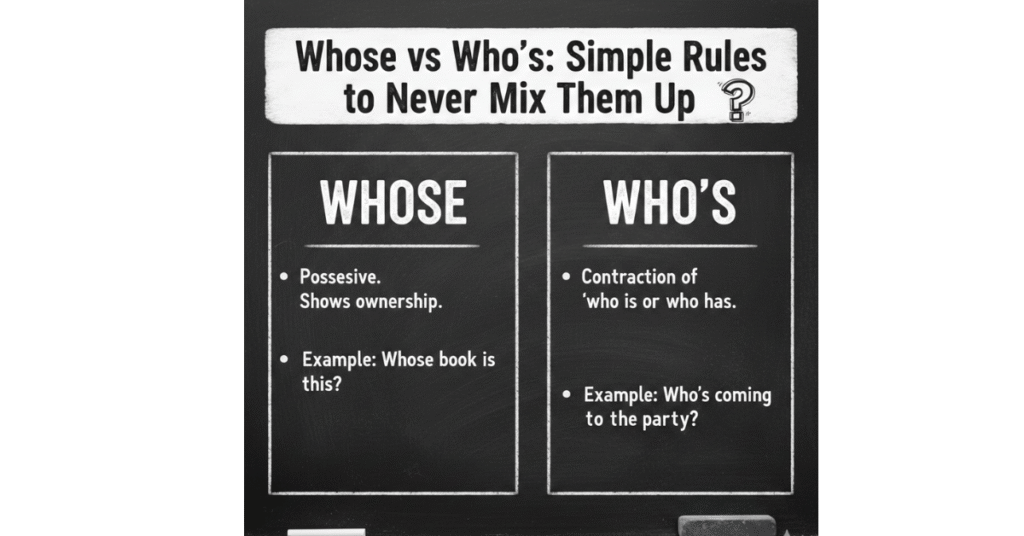

English grammar has a few sneaky troublemakers, and whose vs whos is right at the top of the list. Even confident writers pause for a second when choosing between the two—and honestly, that’s normal.
To make things even more confusing, people often ask related questions like “Can you start a sentence with because?” or how whose vs whos vs whom all fit together. This article breaks it all down in plain English, without grammar jargon overload.
By the end, you’ll clearly understand the whose vs whos definition, how to use each one correctly, and how to avoid common mistakes that trip people up every day.
Whose vs Whos: The Core Difference Quick Answer)
Let’s clear this up right away:
-
Whose = shows possession
-
Who’s = contraction for who is or who has
That’s it. Simple—but powerful.
If you remember just one thing from this article, remember this rule.
Define Whose vs Who’s With Clear Meanings
What Does Whose Mean?
Whose is a possessive pronoun. It tells us that something belongs to someone.
Examples:
-
Whose phone is ringing?
-
She’s the author whose book went viral.
-
Do you know whose car is blocking the driveway?
Tip: If ownership is involved, whose is almost always the right choice.
What Does Who’s Mean?
Who’s is a contraction. It combines:
-
who is
-
who has
Examples:
-
Who’s coming to the meeting?
-
Who’s finished the report already?
-
She’s the manager who’s been here longest.
Quick test: Replace who’s with who is or who has. If the sentence still works, you’re correct.
Whose vs Who’s Definition Side‑by‑Side Comparison
| Word | Meaning | Grammar Role | Can Be Expanded? |
| Whose | Shows possession | Possessive pronoun | No |
| Who’s | Who is / who has | Contraction | Yes |
Whose vs Whos vs Whom: How They’re Different
This is where many writers get stuck.
Whose
-
Possession
-
Refers to people and things
-
Example: The student whose laptop broke left early.
Who’s
-
Short for who is or who has
-
Example: Who’s responsible for this decision?
Whom
-
Object of a verb or preposition
-
Example: Whom did you invite?
Easy trick for whom:
If you can replace it with him or them, whom is correct.
Common Mistakes People Make and How to Avoid Them
Here are the most frequent errors with whose vs who’s:
-
Who’s jacket is this?
Whose jacket is this? -
The employee whose late again apologized.
The employee who’s late again apologized. -
Whose going to lead the project?
Who’s going to lead the project?
Slowing down and doing the expansion test saves you every time.
Can You Start a Sentence With “Because”?
Yes—you absolutely can.
This is a long‑standing grammar myth that refuses to die.
When It Works
You can start a sentence with because as long as the sentence is complete.
Correct examples:
-
Because clarity matters, this guide keeps things simple.
-
Because she prepared ahead of time, the presentation went smoothly.
When It Doesn’t Work
The problem happens when the sentence is unfinished.
Incorrect:
-
Because I was tired.
Just make sure your sentence answers “because… what?”
FAQs: Whose vs Whos Explained Simply
What is the easiest way to remember whose vs who’s?
Try expanding who’s into who is or who has. If it works, use who’s. If not, use whose.
Is “whose” only used for people?
No. Whose can refer to people, animals, and even things.
Can whose be used in questions?
Yes. Whose idea was this? is perfectly correct.
Is it grammatically correct to start a sentence with because?
Yes—as long as the sentence is complete and not a fragment.
How is whose vs who’s vs whom different?
-
Whose = possession
-
Who’s = who is / who has
-
Whom = object of a sentence
Conclusion: Master Whose vs Whos Once and for All
The confusion around whose vs whos is common—but completely avoidable. Once you remember that whose shows ownership and who’s is a contraction, everything falls into place.
And yes, you can start a sentence with because—just finish the thought.
If you want to sharpen your grammar even further, explore related topics like who vs whom, its vs it’s, or there vs their vs they’re to build confidence and clarity in your writing.