

At some point, almost everyone pauses and wonders what is the meaning of life. It might happen during a quiet night, after a major loss, or even in moments of success. The question isn’t dramatic—it’s deeply human.
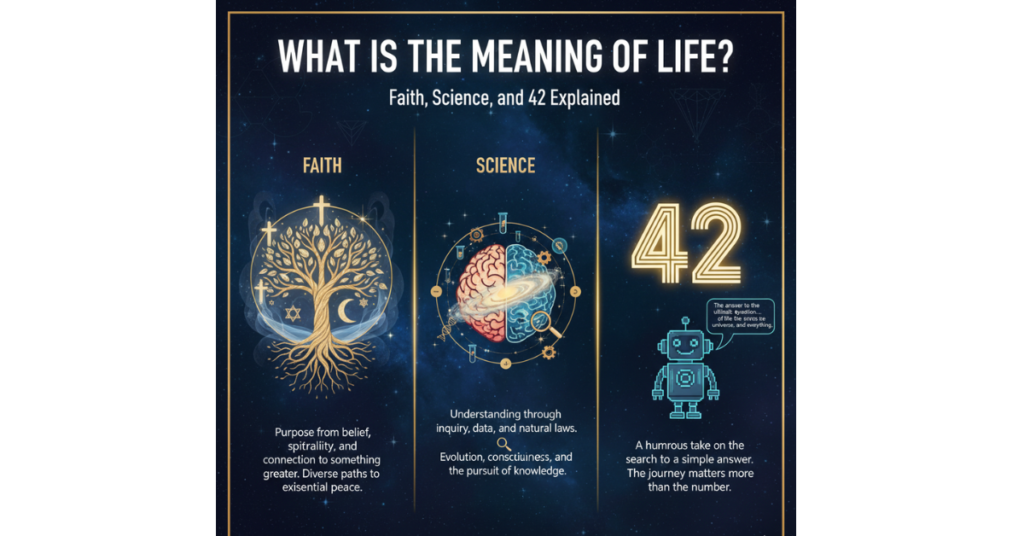
This article explores the meaning of existence through philosophy, science, pop culture, and faith. From the famous “42” answer to what the Bible says about life’s purpose, we’ll break down the most common interpretations in a way that’s practical, honest, and easy to understand.
Why Do Humans Search for Life’s Purpose?
Humans don’t just exist—we reflect. We want our actions to matter.
People often start questioning their purpose when:
-
Life feels repetitive or empty
-
They experience loss or failure
-
Success doesn’t bring expected happiness
-
Beliefs are challenged
Psychologists agree that having a sense of purpose improves motivation, resilience, and mental health.
Philosophical Views on the Meaning of Life
Philosophy doesn’t offer one universal answer—but it offers powerful frameworks.
Ancient Thinkers
-
Aristotle believed life’s purpose was human flourishing through virtue.
-
Stoics focused on inner peace, discipline, and accepting reality.
Modern Philosophy
-
Existentialists argued that meaning is not discovered but created.
-
Life gains value through choices, responsibility, and authenticity.
In philosophy, purpose isn’t handed to us—we shape it through how we live.
What Is the Meaning of Life, the Universe, and Everything?
If you’ve ever searched what is the meaning of life the universe and everything, you’ve seen the number 42.
Why 42 Became Famous
The answer comes from The Hitchhiker’s Guide to the Galaxy. A supercomputer calculates the ultimate answer to existence—and it’s simply 42.
The author later explained the joke wasn’t about the number. It was about how absurd it is to expect a simple solution to such a complex question.
So when people ask what is the meaning of life 42, they’re often embracing humor while acknowledging uncertainty.
Scientific Perspectives on Life’s Meaning
Science doesn’t define purpose in spiritual terms, but it explains how meaning forms.
From research in psychology and neuroscience:
-
Meaning grows through relationships and contribution
-
Helping others increases long-term happiness
-
Purpose improves physical health and longevity
From a scientific view, meaning is emergent, not assigned.
What Is the Meaning of Life According to the Bible?
Faith offers a clearer direction for many people.
What Is the Meaning of Life in the Bible?
Biblical teachings emphasize:
-
Loving God
-
Loving others
-
Living with humility, faith, and obedience
Key verses include:
-
Ecclesiastes 12:13 — life’s duty is devotion to God
-
Matthew 22:37–39 — love God and your neighbor
In Christianity, purpose is rooted in relationship, not achievement.
Is There One Final Meaning of Life Answer?
Probably not—and that’s okay.
For some people, the answer lies in:
-
Faith
-
Family
-
Service
-
Growth
-
Creativity
For others, it changes over time. The absence of a single universal answer doesn’t make life meaningless—it makes it personal.
Common Ways People Find Meaning in Everyday Life
Across cultures, people often discover purpose through:
-
Deep relationships
-
Helping others
-
Personal growth
-
Spiritual practices
-
Creating or building something meaningful
Meaning is often found in action, not theory.
FAQs About Life’s Meaning
Is there one true meaning of life?
No single answer fits everyone. Meaning is shaped by beliefs, values, and experiences.
Why is 42 linked to life’s meaning?
It’s a symbolic joke highlighting the absurdity of seeking simple answers to complex questions.
What does the Bible say about life’s purpose?
The Bible teaches that life’s purpose is to serve God and live with love and integrity.
Does science reject meaning?
No. Science explains how humans experience meaning rather than denying it.
Conclusion: Finding Meaning That Actually Matters
So, what is the meaning of life? It may not be a sentence, number, or rule—but a direction. Whether you look to faith, philosophy, science, or personal values, meaning grows from how you live, not just what you believe.