
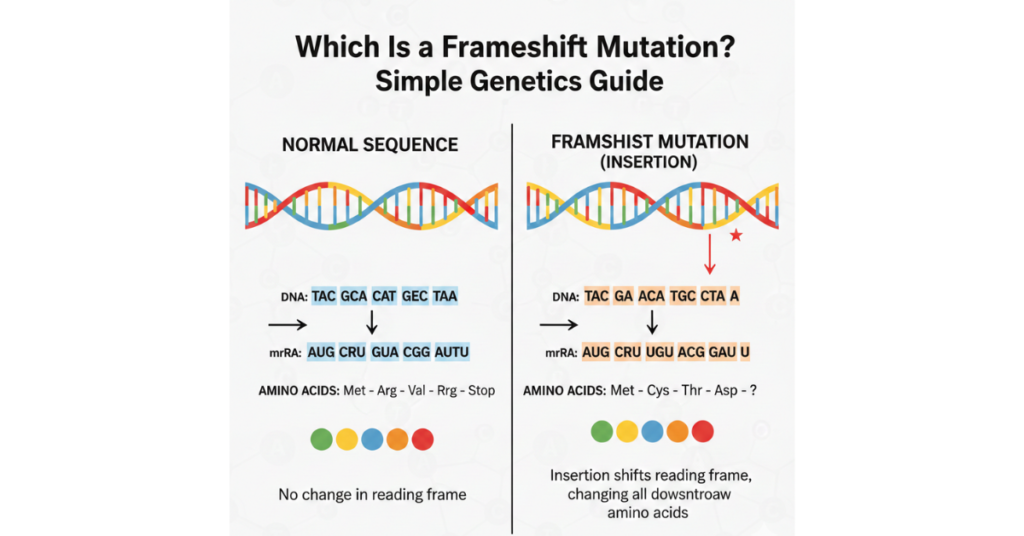

Ever wondered which is a frameshift mutation? substitution nonsense silent deletion. And why biology teachers make such a big deal about it? You’re not alone. Genetic mutations can sound intimidating at first, but once you break them down, they’re surprisingly logical—and even fascinating.
In this article, we’ll clearly explain which is a frameshift mutation? substitution nonsense silent deletion, using simple language and real-world examples. By the end, you’ll know exactly how frameshift mutations work, why they matter, and how they differ from other common mutation types.
What Is a Genetic Mutation?
A genetic mutation is any change in the DNA sequence. DNA is read in groups of three nucleotides called codons, and each codon codes for a specific amino acid.
When a mutation alters how these codons are read, it can change the resulting protein—sometimes mildly, sometimes dramatically.
Which Is a Frameshift Mutation?
Deletion is a frameshift mutation
when nucleotides are removed and not in multiples of three)
A frameshift mutation occurs when the DNA reading frame shifts, changing every codon after the mutation point. This usually happens due to deletions or insertions of DNA bases.
Key takeaway:
Among substitution, nonsense, silent, and deletion, deletion causes a frameshift mutation.
Why Is It Called a “Frameshift” Mutation?
DNA is read like a sentence with no spaces:
THE CAT ATE THE RAT
Remove one letter:
THC ATA TET HER AT
Suddenly, the entire meaning changes. That’s exactly what happens during a frameshift mutation—the “reading frame” shifts.
How Deletion Causes a Frameshift Mutation
What Happens During a Deletion?
-
One or more DNA nucleotides are removed
-
If the deletion is not a multiple of three, the reading frame shifts
-
Every codon downstream is altered
-
The protein is usually nonfunctional
Why It’s Dangerous
Frameshift mutations often lead to:
-
Truncated proteins
-
Loss of protein function
-
Genetic disorders (like cystic fibrosis or Tay-Sachs disease)
Comparison: Frameshift vs Other Mutation Types
1. Substitution Mutation
A single nucleotide is replaced with another.
-
Does not cause a frameshift
-
Can be mild or severe
-
Includes silent and nonsense mutations
2. Silent Mutation
A type of substitution mutation.
-
No frameshift
-
Amino acid remains unchanged
-
Often has no effect on the organism
3. Nonsense Mutation
Another type of substitution mutation.
-
No frameshift
-
Creates a premature stop codon
-
Protein is shortened
4. Deletion Mutation
One or more nucleotides are removed.
-
Causes a frameshift mutation
-
Alters all downstream codons
-
Usually has severe effects
Quick Summary Table
| Mutation Type | Frameshift? | Protein Impact |
| Substitution | No | Varies |
| Silent | No | None |
| Nonsense | No | Truncated |
| Deletion | Yes | Severe |
Why Frameshift Mutations Matter in Real Life
Frameshift mutations are linked to:
-
Genetic diseases
-
Cancer development
-
Protein malfunction
-
Evolutionary changes
Because they alter large portions of DNA instructions, they’re among the most disruptive mutation types.
FAQs
Which is a frameshift mutation? substitution, nonsense, silent, or deletion?
Deletion is the correct answer because it shifts the DNA reading frame.
Are all deletions frameshift mutations?
No. Deletions in multiples of three remove amino acids but do not shift the reading frame.
Can insertions cause frameshift mutations?
Yes. Insertions not in multiples of three also cause frameshift mutations.
Are frameshift mutations always harmful?
Most are harmful, but in rare cases, organisms can tolerate or adapt to them.
Is a nonsense mutation worse than a frameshift mutation?
Frameshift mutations are usually more severe because they alter many amino acids, not just one.
Conclusion
So, which is a frameshift mutation? substitution nonsense silent deletion The answer is clear: deletion. Unlike substitution, nonsense, or silent mutations, deletions disrupt the entire reading frame of DNA, often leading to serious biological consequences.
If you’re studying genetics, preparing for exams, or just curious about how DNA works, understanding frameshift mutations is essential. Want to dive deeper? Explore related topics like insertion mutations, genetic disorders, or protein synthesis to keep building your knowledge.