
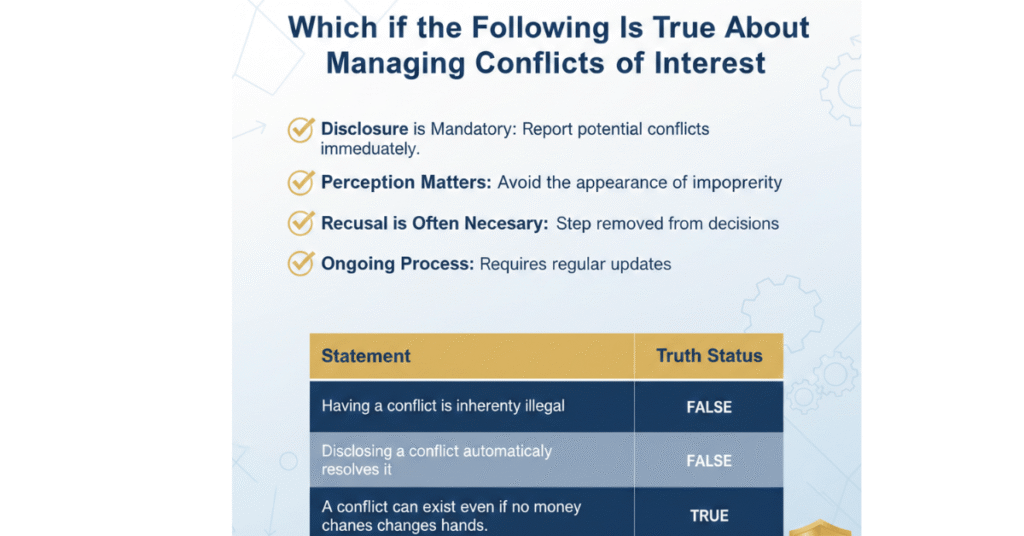

Conflicts of interest show up more often than we like to admit—in business, healthcare, finance, education, and even everyday workplace decisions. Which of the following is true about the management of conflicts of interest? The short answer is that effective management isn’t about pretending conflicts don’t exist; it’s about identifying, disclosing, and controlling them before they cause harm.
Because conflicts of interest are a normal part of professional life, learning how to manage them properly is essential for maintaining trust, compliance, and ethical standards. In this article, we’ll break down what’s actually true about managing conflicts of interest, clear up common misconceptions, and explain best practices in a way that’s practical and easy to understand.
What Is a Conflict of Interest?
A conflict of interest occurs when personal, financial, or professional interests interfere—or appear to interfere—with objective decision-making.
Common Examples of Conflicts of Interest
-
A manager hiring a close family member
-
A financial advisor recommending products they earn commissions from
-
A researcher funded by a company whose product they are evaluating
Conflicts don’t automatically mean wrongdoing. The issue arises when they are hidden or unmanaged.
Which of the Following Is True About the Management of Conflicts of Interest?
The Correct Statement Explained
The true statement about the management of conflicts of interest is that they must be disclosed and actively managed, not ignored or eliminated entirely.
This is a key principle recognized by regulators, ethics boards, and professional organizations worldwide.
Why This Matters
-
Conflicts are often unavoidable
-
Transparency builds trust
-
Proper management protects individuals and organizations
Trying to eliminate every conflict is unrealistic. Managing them responsibly is the real goal.
Key Principles of Managing Conflicts of Interest
1. Disclosure Is the Foundation
Openly declaring a conflict allows others to assess risk objectively.
Examples of disclosure include:
-
Declaring financial interests
-
Reporting personal relationships
-
Notifying compliance or ethics committees
2. Management, Not Denial
Once disclosed, conflicts can be managed through:
-
Oversight or supervision
-
Recusal from decision-making
-
Role reassignment
3. Documentation and Accountability
Clear records protect everyone involved and demonstrate ethical intent.
Common Myths About Conflicts of Interest
“If I Have a Conflict, I Must Step Away Completely”
Not always. Many conflicts can be managed with safeguards in place.
“Only Financial Conflicts Count”
False. Personal, relational, and professional conflicts can be just as impactful.
“Disclosure Alone Is Enough”
Disclosure is necessary, but it’s only the first step. Active management is essential.
Best Practices for Conflict of Interest Management
Here’s what effective organizations consistently do:
-
Establish clear conflict of interest policies
-
Require regular disclosures
-
Train employees on ethical decision-making
-
Review conflicts periodically
-
Enforce consequences for non-disclosure
These steps help create a culture of integrity rather than fear.
Legal and Ethical Standards to Know
Different industries have formal guidelines, including:
-
Corporate governance codes
-
Healthcare compliance rules (e.g., Sunshine Act in the U.S.)
-
Academic research ethics policies
Why Proper Conflict Management Builds Trust
Trust is fragile. Poorly managed conflicts can damage:
-
Reputation
-
Legal standing
-
Stakeholder confidence
On the flip side, transparent conflict management:
-
Enhances credibility
-
Strengthens leadership integrity
-
Encourages ethical behavior across teams
FAQs
What is the main goal of managing conflicts of interest?
The goal is to ensure decisions are fair, objective, and in the best interest of stakeholders.
Is having a conflict of interest illegal?
Not usually. Failing to disclose or manage it properly can be illegal or unethical.
Who is responsible for managing conflicts of interest?
Both individuals and organizations share responsibility.
Can conflicts of interest ever be avoided?
Some can be avoided, but many are unavoidable and must be managed instead.
Which of the following is true about the management of conflicts of interest?
They require transparency, disclosure, and active oversight—not denial or concealment.
Conclusion
So, which of the following is true about the management of conflicts of interest? The truth is simple but powerful: conflicts are normal, but hiding them is not. Ethical organizations don’t pretend conflicts don’t exist—they confront them with transparency, structure, and accountability.