
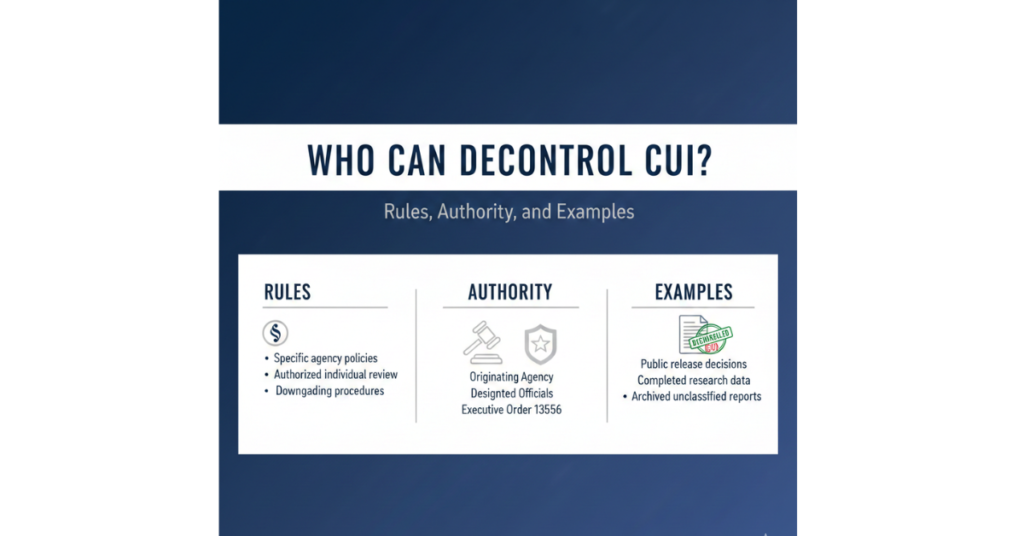

Because Controlled Unclassified Information is regulated to prevent improper disclosure, it’s critical to understand who actually has the authority to remove CUI protections. Many people assume access equals permission—but that’s not how the system works.
This guide explains how CUI decontrol authority works, clarifies common misconceptions found in training materials, and explains the role of the originating organization and designated officials under federal policy.
What Does Decontrolling CUI Mean?
Decontrolling CUI means formally removing CUI markings once the information no longer requires safeguarding.
This may occur when:
-
The information becomes publicly releasable
-
A governing law or regulation changes
-
The sensitivity of the data expires
-
An authorized official approves release
Because CUI is governed by regulation—not classification—this process follows strict rules.
Who Has the Legal Authority to Remove CUI Controls?
The Originating Organization Holds Primary Authority
In most cases, the organization that originally designated the information as CUI retains control over whether it can be decontrolled.
Authority may be exercised by:
-
The originating agency
-
A designated CUI program official
-
A person with formally delegated approval authority
Without written delegation, individuals handling the information cannot make that decision themselves.
Clarifying the Role of the OCA
Does an OCA Automatically Have CUI Decontrol Power?
No. This is one of the most misunderstood points in training.
An Original Classification Authority (OCA) is associated with classified information. CUI is unclassified, which means:
-
Classification authority does not automatically apply
-
OCA status alone does not grant decontrol permission
-
Authority must be explicitly assigned for CUI matters
This distinction is defined under 32 CFR Part 2002, not executive classification orders.
Why Quizlet Answers Can Be Misleading
Many learners encounter simplified answers on study platforms.
What They Get Right
-
Decontrol decisions belong to the information owner
-
Not every user can remove markings
What They Often Oversimplify
-
“Authorized holder” does not mean general access
-
Rank does not equal permission
-
Delegation must be documented
Quiz tools are useful for studying, but official sources should always be the final reference.
Who Is Not Permitted to Remove CUI Markings
To avoid compliance issues, it’s important to know who lacks authority:
-
Employees without delegated approval
-
Contractors or vendors
-
Supervisors without CUI designation
-
Users assuming authority based on job title
Because CUI authority is role-based, assumptions can lead to violations.
How the Decontrol Process Typically Works
Standard Review Steps
-
Verify the CUI category
-
Confirm current laws and policy guidance
-
Identify the owning organization
-
Obtain approval from the designated authority
-
Remove markings correctly
-
Record the decision for audit purposes
Documentation is essential, especially during inspections.
Why Proper Decontrol Matters
Incorrect removal can:
-
Expose sensitive government data
-
Lead to compliance violations
-
Trigger audits or corrective actions
-
Damage institutional trust
Correct handling, however, supports transparency and responsible information sharing.
Frequently Asked Questions
Can any employee decide when CUI is no longer needed?
No. Only authorized officials designated by the originating organization may approve decontrol.
Does access to CUI mean authority to release it?
Access and authority are separate. Having access does not grant decision-making power.
Can CUI become public information?
Yes—once reviewed and formally approved for release.
Does CUI expire automatically?
No. It remains controlled until officially decontrolled.
Are training platforms reliable for CUI rules?
They’re useful for learning, but official federal guidance should always be used for decisions.
Conclusion
Because CUI protects sensitive but unclassified information, authority to remove those protections is intentionally limited. The originating organization—or a formally designated representative—must approve any decontrol action.
If you work with federal data or are preparing for compliance training, always verify authority before removing markings. When in doubt, follow official policy and documented delegation.